

“Only ignorant journalists and Keynesian pseudo-economists call these episodes ‘miracles’.”
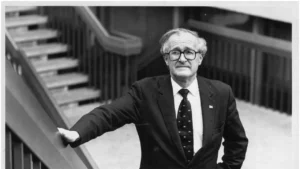
When Wolfgang Kasper arrived in Australia in 1973, it was only meant to be a short academic visit. He had come via Malaysia where he was an economic advisor to the government, and before that he had worked for the German Council of Economic Advisors and then the Institute of World Economics in post-war West Germany. When he arrived in Australia, Kasper “encountered an intensely unhappy social atmosphere”, characterised by “fiscal profligacy, loose monetary policy, currency devaluation and waves of wage increases and strikes”. Over the next 30 years Australia would become economically unrecognisable. This newly arrived German economist would play a key role.
Kasper trained as a linguist and an economist in Germany, and worked in Germany, Spain and Malaysia. He arrived with key economic lessons from those countries. “My views were shaped by the two formative experiences as a young economist,” he later wrote, “first the post-war economic recovery of West Germany, then the take-off into accelerated growth in East Asia.”
The West German experience after the Second World War – often called the Wirtschaftswunder, literally “economic miracle” – saw a rapid reconstruction and development under the stewardship of Minister of Economics (and later Chancellor) Ludwig Erhard and his Freiburg School economists. Kasper took note of what was happening as a young economist, but despised the term used to describe them. “Only ignorant journalists and Keynesian pseudo-economists call these episodes ‘miracles’,” Kasper told an audience in 2016. “The ‘German economic miracle’ and later the ‘East Asian economic miracle’ demonstrated what free people do in a free economy under the rule of law. Only observers who refuse to learn this fundamental lesson will call it a miracle.”
In both West Germany and East Asia, Kasper wrote, “governments got out of the way, opened markets to competition and stuck to fiscal and monetary discipline. The people responded by working, saving and taking risks, and their wealth creation soon resulted in confidence and optimism.”
Kasper had come to Australia to teach at the Australian National University, but he wasn’t content to quietly work in the economics department. He later recalled that he was perplexed at the state of Australia, and the attitude of Australians, given that Australia was “rich in natural resources, located in the booming East-Asian time zone, with essentially good social and legal institutions inherited from Britain, a high savings rate and a reasonable educated population.”
“The sombre collective mood seemed wholly unnecessary,” he later wrote. “I diagnosed the root cause of it all as pervasive supply-side rigidity and suggested a therapy: deregulation all around, beginning with pre-announced, gradual tariff cuts and a commitment to macro-economic discipline.”
This was met with amused headshakes at the Australian National University and the Canberra branch of the Fabian Society. Canberra insiders told me that what I proposed was – in the Australian setting – naïve, outrageous and basically undoable. What I of course failed to realise at the time was that the people I met suffered from deep and lasting damage to the national psyche inflicted by the long-lasting paternalism of the Australian Settlement. People were used to the fundamental certainties of steady, though mediocre, income growth and egalitarian outcomes for all thanks to pervasive visible-hand interventions.
As he got settled in and expanded his circles, however, Kasper found others who were keen to see such reforms. Among them were the dries. “Eventually, I discovered more and more Australians who agreed with my diagnosis and therapy – business people, a few civil servants, a few journalists and some parliamentarians, who were becoming known as the ‘Dries’ and were Fraser’s only effective opposition at the time.”
Together with a group of other academic economists and Douglas Hocking, the chief economist at Shell Australia, Kasper authored an economic study of Australia (funded by Shell), Australia at the Crossroads: Our choices to the year 2000. The study, published in 1980, surveyed the past 30 years of economic performance in Australia, arguing “that many of the key post-war trends in Australian life broke simultaneously in the 1970s.” The post-war trends included historically high per capita economic growth, stable inflation, low unemployment, and greater levels of investment. But this came to an end, globally, in the early 1970s with a broad-based stagnation, high inflation, and higher unemployment.
As a result, a great deal of insecurity has overcome Australians, both with regard to their personal futures and with regard to the future of the country. Many Australians have become pessimistic and risk-averse. Others who had hoped for progress in economic and social affairs through collective action by an enlightened government have been disillusioned by the results.
Crossroads set out two pathways forward and explored how different Australia would look in the year 2000 if one path was taken over another. Down the first path – The Mercantilist Trend – economic reform was avoided, Australians and their economic life remained highly regulated, and privilege prevailed over the broader national interest. Down the second path – The Libertarian Alternative – the economy was deregulated, markets were allowed to operate effectively, special interests would cease to receive special favours, there would be more international trade, higher investment, higher wages and national wealth, and lower unemployment. Kasper and his co-authors set down specific policies which could be pursued if politicians wanted to pursue The Libertarian Alternative.
John Hyde described the book as the “inspiration of the dry movement in federal parliament after the 1980 election.” After Jim Carlton suggested that the dries get a group of people together to discuss Crossroads, Hyde wrote to a wide range of politicians, advisors, public servants, academics, think tankers, industry groups, and business people, inviting them to take part in the inaugural Crossroads Conference in February 1981. The participants, and those who joined them later – the Crossroads Group – became, in the words of Paul Kelly, “the nucleus of the ‘free market’ counter-establishment of the 1980s. Those who stuck gave their careers, minds or money to the cause. Within the decade, the Crossroads core group and its ideas had taken control of non-Labor politics in Australia.”
The policies that Kasper advocated for in Crossroads and through the Group were largely implemented by the Hawke, Keating, and Howard governments. He was one of the key intellectual contributors to the broader dries; John Hyde later said that he “owed him for economic education and advice that stopped me from error that would have denied me having any influence.”
Kasper continued his contributions to the public debate almost up until he passed away in 2023. But in his later years he became especially concerned with the economic stagnation Australia was again experiencing, which reminded him of the 1970s. In 2015 he authored a paper for the Centre for Independent Studies, The Case for a New Australian Settlement, in which he argued that it was time for “a cultural counter-revolution that reawakens the traditional Australian spirit of self-reliance and can-do optimism.”
After almost a generation of uninterrupted growth, the Australian economy – and the public mood – have lately been drifting into a sustained slowdown. In many respects, this pattern resembles what happened in earlier long waves of accelerating, then decelerating growth. Although history never quite repeats itself, it appears we are now facing conditions not dissimilar to the traumatic Whitlam-Fraser era: rising unemployment, persistent public deficits, investor hesitation, toothless monetary-fiscal policies, heightened social and political antagonism, and widespread pessimism. A generation ago, this crisis was overcome by gradual bi-partisan economic reforms (1983-2003) that improved economic freedom, favoured the producers and inspired enterprise…
A national conversation should now be started about what fundamental values and policy positions we can and should embrace in the future, so producers in Australia can again envisage the future with a renewed sense of confidence and citizens can again identify more proudly with this country and its civic culture. In my opinion, we need to reaffirm that our society has been and will be based on respect for individual freedom; that Australia must be pro-actively open to the world and the future; that our governments have again to become small, secular and modest; and that this country is and will remain part of Western civilisation…
The task is to avoid a re-run of the protracted crisis of poor economic performance and social pessimism in the Whitlam-Fraser years.